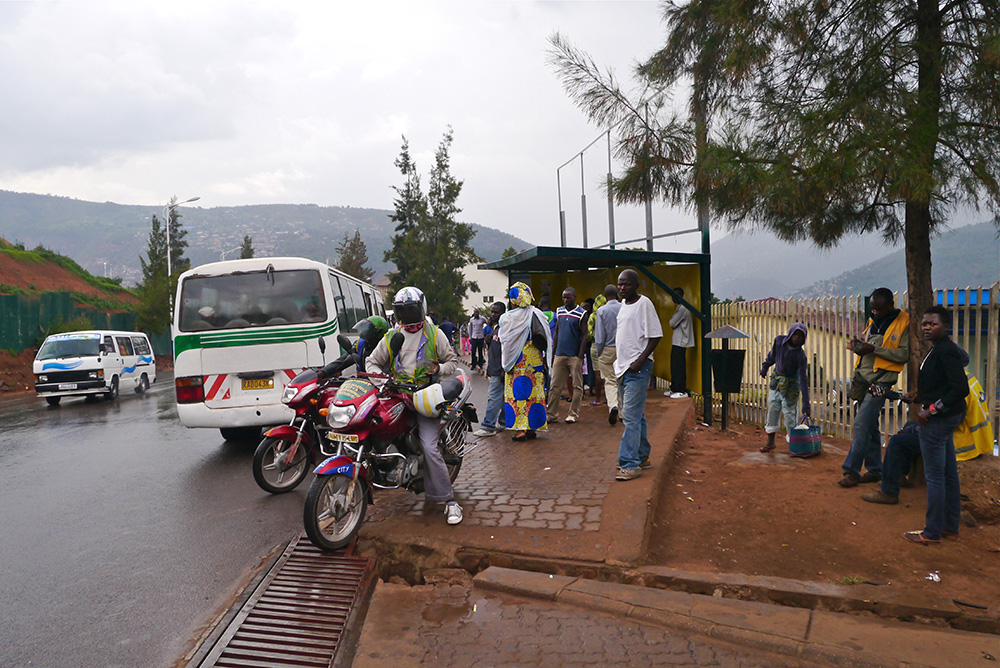
Kigali Busstop
In the event of rain, take shelter at the nearest bus stop. With a bit of luck you stay dry a little longer.
People move up without complaining, you’re all in the same boat. For the ubiquitous white minibuses, rain is a blessing.
Those who normally walk, mode of transport number one in many African countries, might take a taxi today.
Taxi’s, more specifically minibuses, can be considered mode of transport number two in these countries,
or even number one when you intend to discuss public transport.
In Kinyarwanda they’re poetically named Twegerane, squeeze together, since it is customary to seat more passengers than actual seats available.
Not that Twegerane are stuffed, let’s just say optimally filled up. Because the rain is nowhere near stopping, I take a ride.
The taxi is full already but I’m courteously granted a space. A tip-up chair pops out in the front row.
Its slight slant makes me strain my muscles in strange ways on Kigali’s curvy slopes.
Gospel blares out of the speakers and the fee is very affordable.
The only negative effect is a slight feeling of seasickness after getting out.
Modern times are approaching and Twegerane may become a rare sight.
Rwanda’s capital Kigali is a swift growing city where loads of commuters depend on the Twegerane for their daily rides.
It’s a chaotic system that requires great patience and some courage to boot.
Timetables don’t exist, buses leave once full. Traffic can be hazardous.
With an ever increasing population streets get clogged and demands for transport cannot be met.
Rwanda happens to have a very ambitious government, envisaging Kigali as the continents’ equivalent of the proverbial Utopia.
Alongside futuristic buildings, fountains, green spaces, shopping centres and pedestrian walkways,
this future Kigali will boast an effective public transport system.
It should reduce traffic congestion, energy use and pollution and increase growth of the national economy, leading to poverty reduction.
This new transport system has been given the highest priority.
The prospect of using new, safe and punctual buses has been applauded by Kigali commuters.
But the scenario for improvement seems unrealistic so far and, according to the opposition,
is yet another scheme for President Kagame’s firmly ruling RFP to enrich itself.
Here’s where the Utopian character becomes clear.
Pressed by government-approved plans Kigali’s authorities handed over the playground
of the mainly privately owned Twegerane to three large transport companies.
Word has it that these are associated with the aforementioned RFP.
Their buses are supposed to exclusively cover the main roads, both in Kigali and the rest of the country.
Twegerane can still serve the roads in between, leaving them with shorter rides and fewer passengers.
Besides banishment from the main roads, they have also been subjected to an intricate system of daily taxes.
Separately, fees were introduced for authorisation, insurance, uniforms, technical control etcetera.
Nothing wrong with rules and regulations, but it’s unknown where the tax-money goes or what it’s used for.
Twegerane owners had to sign contracts for new operating hours, 14 a day, 7 days a week. No wonder so many nasty accidents occur.
Meanwhile, in an ideal world the new, big buses should drive at intervals of 5 minutes during rush hour en every 15 minutes during the rest of the day.
The transport companies fear that these time schedules cannot be observed. They actually know this for certain,
as the pilot for the bus-service clearly showed that schedules were never kept. Drivers chose the busiest routes to make more money.
On top of this traffic jams are rife, especially with more and more privately owned cars flooding the roads.
The Mayor of Kigali reacted with beautiful propaganda:
(The) transport system in Kigali…failed because current transport players are not reliable and some are motivated by profit and not serving Rwandans…
And: “The three investors will be held accountable if transport crises arise again..”
At the time of the pilot there was no specific enforcement to keep the transport-companies in line.
Apparently this time around teams will be ready to roam the streets to seek out disobedient busdrivers.
These will be reported and measures will be taken.
It seems any measures will be inadequate. The current bus-capacity for public transportation is about a third of what’s needed.
One hundred and eighty five buses and three hundred and fifty mini-buses extra are necessary to meet demand.
Who’s supposed to pay for these extra investments? Meanwhile the once very profitable Twegerane business is slowly fading away.
A business in which one minibus could provide for at least three families: the owners’, the conductors’ and the drivers’.
The opposition party leader that cried out on behalf of the Twengerane may very well be hit by a bus; a big one that is.
