Lightning Chess
Were it not for the cold, I might have stayed a bit longer.
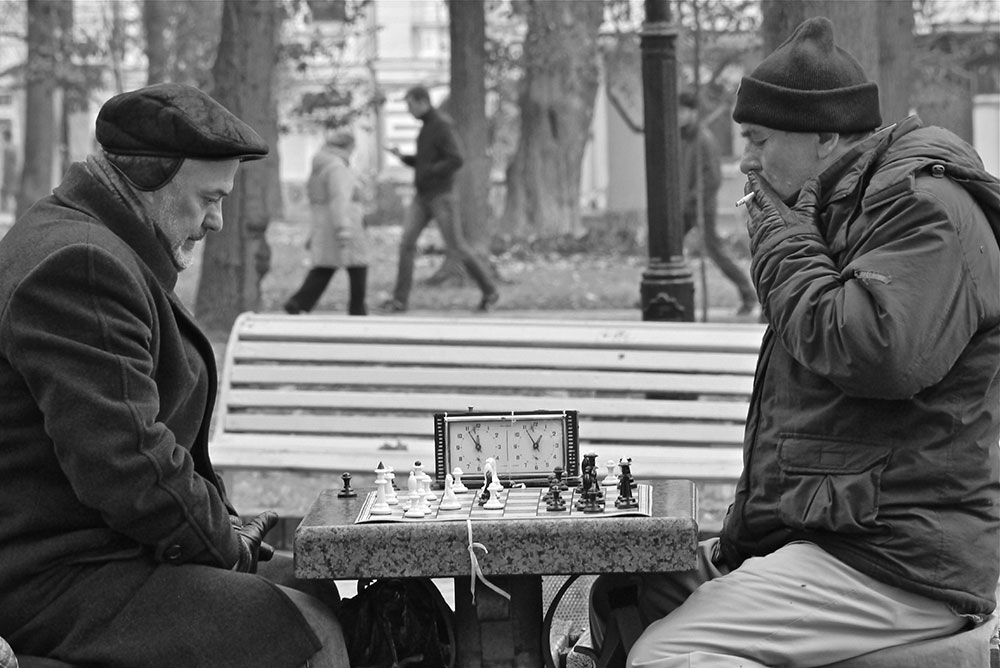
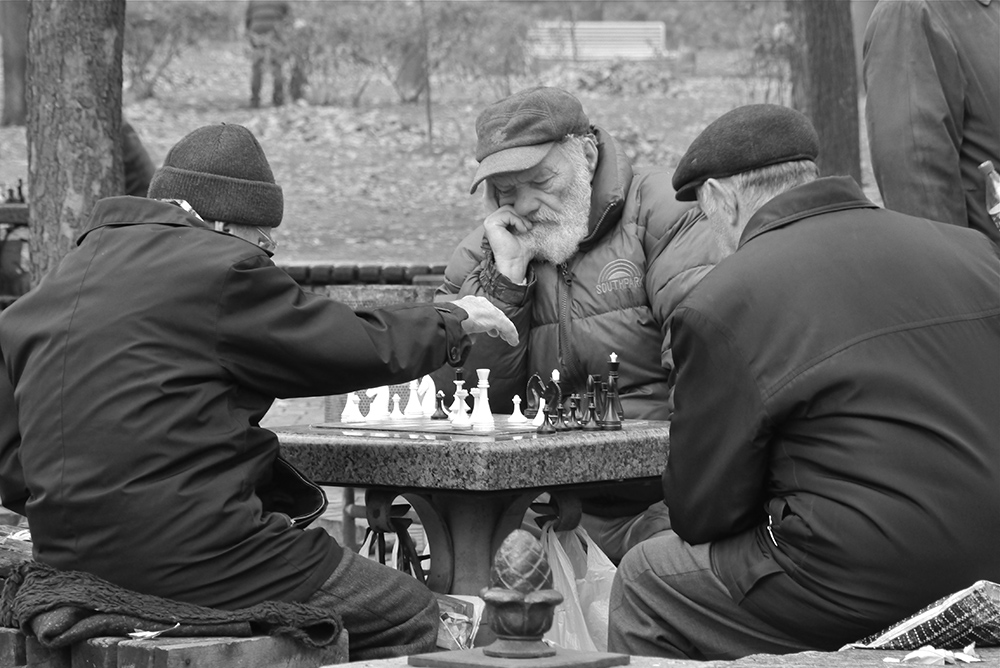
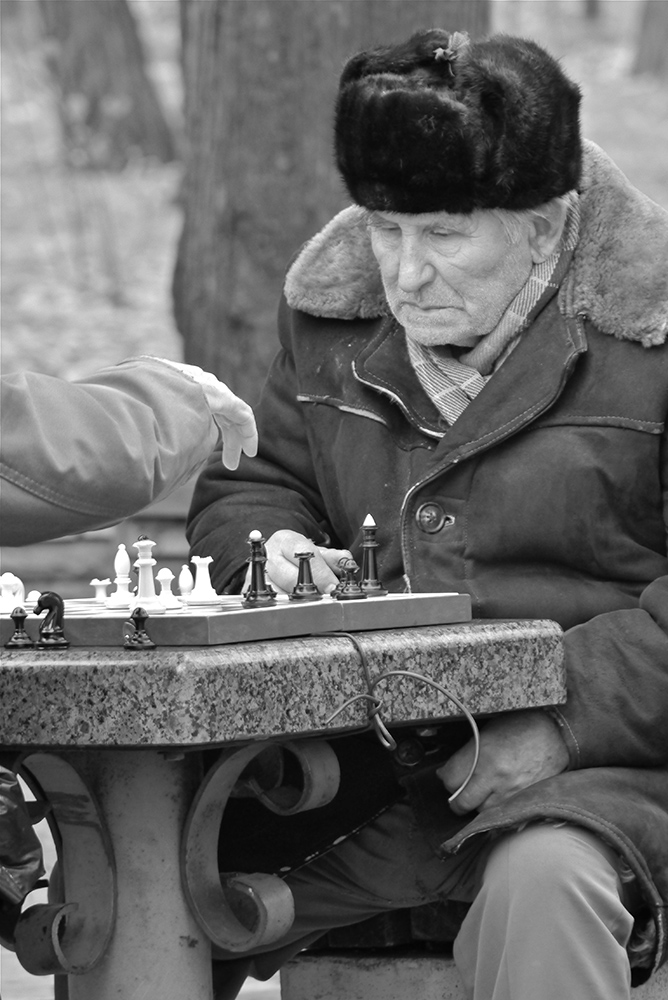
The old men that hold my focus seem to be less bothered with the outside temperature.
They are engaged in what appears to be a game of lightning chess.
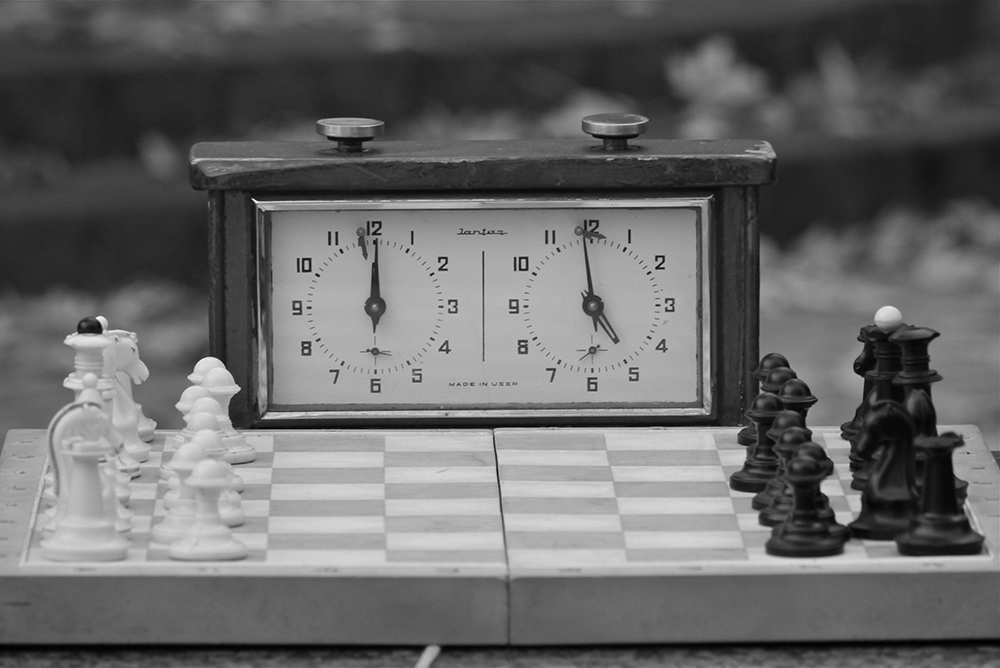
A chess-clock flanks them, and they batter it fanatically.
I’ve never managed to master even the basic rules of chess.
Games were not played in our family, those that could have enhanced the intellect included.
I guess they were generally deemed to be a waste of time. I may have to reconsider;
these guys appeal more to me than the many elderly at home, locked up in overheated
rooms glued to their television sets. At least they seem to derive pleasure from their game and,
judging by the swiftness of moves, their brain function is still very much intact.
I muse over the ideological use of chess in the former Soviet Union,
where the game was widely taught, promoted and refined. I can still name the great
Soviet chess masters of my youth: Karpov, Kasparov and Kortsnoj. They and many
other prominent Soviet players held the chess world title in Soviet hands almost
uninterruptedly for some 40 years. How did this come to be?
Ironically chess, the once preferred game of nobility and upper classes,
became a means of reformation for the Bolshevist revolutionaries.
This came about sort of accidentally, because a chess master happened
to be at the foundation of the Communist state and even more precisely its military wing.
The armed forces later known as the Red Army still had to be established and a
certain Il’in-Zhenevskii, a chess fanatic, stood at their helm.
He managed to incorporate chess, in addition to sports, into military training,
convinced that the study of chess “enhanced boldness, inventiveness,
will power and strategic ability”, all direly needed in the military supporting
the revolutionary cause. The idea of tutoring by chess was implemented even
more widely as a means to train the newly formed Party cadre.
Because the revolution was still in its embryonic phase, a strong cadre needed
to be formed. The ideal communist should above all have “an iron determination to
overcome all obstacles”, and mastering chess would provide such stamina.
A nationwide program for chess-education was rolled out next, after a large scale,
state sponsored study had been carried out in the 1920ies, proving the dialectical and
intellect-enhancing qualities of chess.
As it happened the labouring masses in the new republic were in desperate need of both
intellectual and cultural development. After all, the largely illiterate and poor Russian people
were swept into communism from scratch. Russia in fact lacked all factors for a successful
revolution described by Marx, such as economical development, democratic tradition and a cultured
and political aware proletariat. Chess as a political means provided the opportunity to at least
fill some of the gap between practise and theory.
Internal battles over the advisable way of deployment were fought: playing strictly for
pleasure was highly suspect and engagement with bourgeois players from the west could
only be permitted if it served a political purpose. It became a big thing nevertheless:
state-sponsored, closely related to labour organisations and sports/education bureaucracy.
Whether the masses truly became enlightened through chess cannot be verified,
but fact remains that the Soviet Union nurtured many high level chess players.
It seems that after the fall of the Soviet empire, chess has taken a fall as well.
No longer financed by government organisations, only the allure of being a chess master remains.
Children are still educated, but other countries have taken the lead in world championships.
Even president Putin allegedly prefers to make strategic decisions based on judo, the martial art
in which he possesses a black belt.
A judo master uses unexpected, explosive strikes to throw his opponent off balance, then
makes use of the opponents’ height and weight to tackle and overpower him. This change
of game has not yet been recognised widely, but seems worthy to incorporate in the
analysis of Russian politics. It’s always better to expect the unexpected.
That leaves the former Soviet Republic Kalmykia to defend chess’ honour. Its former
President, the multimillionaire businessman and master player Kirsan Ilyumzhinov,
has firmly embedded chess in hearts and minds of the nation. He made chess compulsory
in all primary schools, thus generating many champions. The country hosted important
international chess tournaments, but also had several chess-related scandals.
After revealing that a disproportionate amount of government money was spent on chess,
the journalist who raised the alarm was consequently stabbed to death. Involvement
of mister Ilyumzhinov was never established. The latter also had an entire village built
to host a chess Olympiad in 1998. The games had to be rescheduled because the village
was not finished on time; it stands abandoned ever since.
This year mister Ilyumzhinov has been holding the position of chairman of the world
chess organization FIDE for twenty years. His continuous presidency has been heavily
disputed by other FIDE members, who accuse him of corruption and installment of a
Soviet like institution within the organization. He has beaten all his challengers
in various elections by large majority. Apparently the allegations have not lead
to a checkmate yet.
