"Wathint' abafazi, Strijdom!"
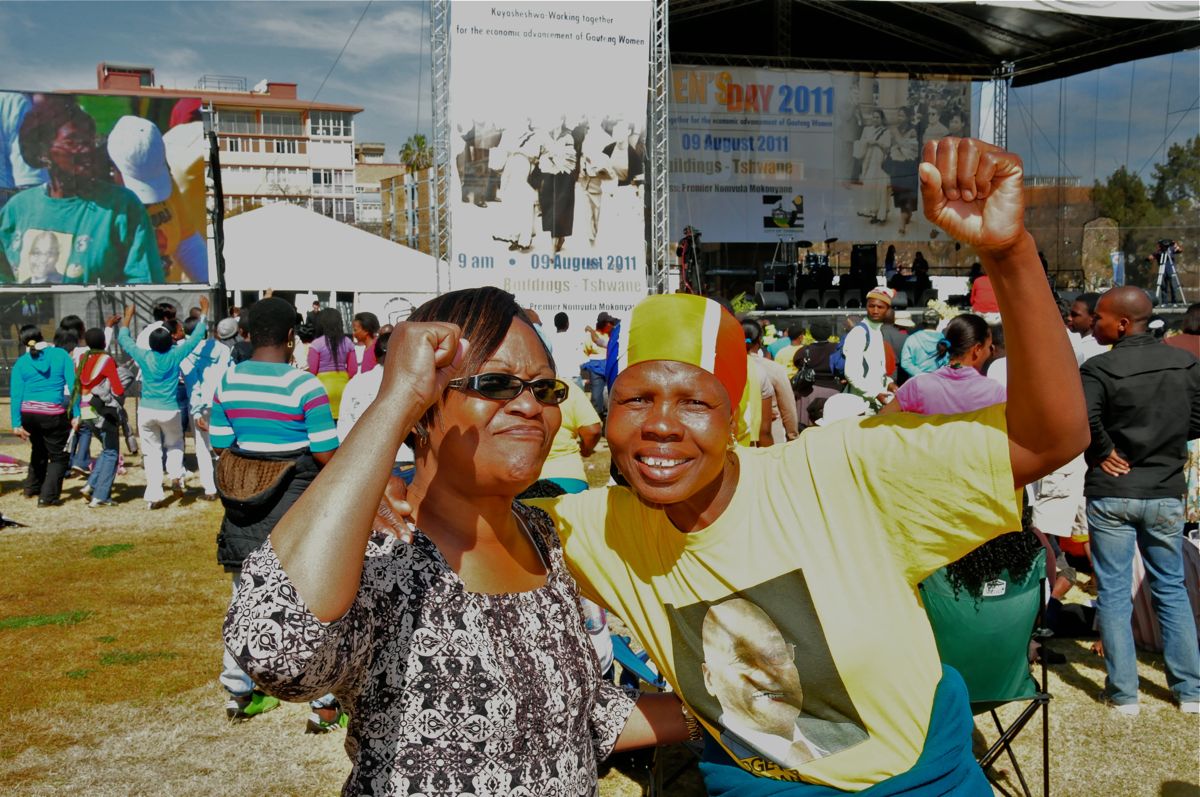
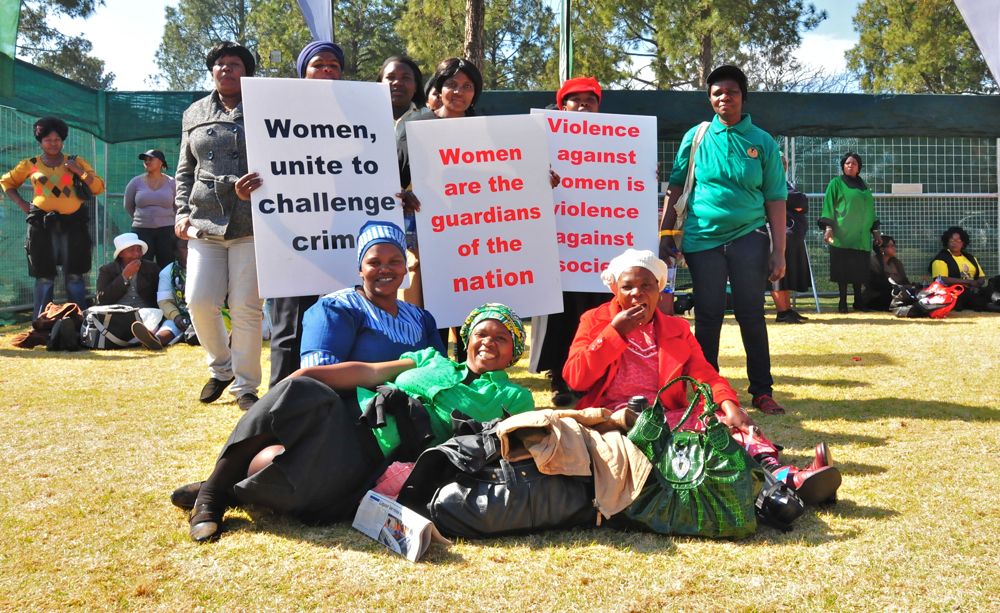
Vrijheid Park, Pretoria, National Women’s Day. Maybe it’s because the city has remained furtively white that the rainbow nation fails to manifest itself today. Apart from mrs. Annetjie Winnaar, a charming old lady well into her seventies and myself, no whites have shown up to engage in this celebration of women’s liberation. “They think it’s an ANC-demonstration”, a lady states when I ask her. “Well, it’s not!” Actually this is the 55th birthday of a multi-racial rally, organized by the Federation of South African Women in cooperation with the ANC Womans League, that took place on August 9, 1956. Then some 20.000 South African women of all races marched the Union Buildings in Pretoria to deliver a petition to the former Prime Minister J.G. Strijdom. The women firmly opposed the “pass laws”, that severely restricted freedom of black and coloured people. In the early 1900’s these laws took shape in Orange Free State. After years of protest and opposition, the “pass laws” were more or less finalized in the “Blacks Act no. 67” of 1952. As of then all black people over the age of 16 in the whole of South Africa were to carry identification papers at all times. Different races were forced to live in different residential area’s and people were violently removed from off-limits area’s. A black person could not enter another racial area without identification. The peacefully protesting women came to present over 100.000 signatures to a Prime Minister that was “conveniently absent” at the time, thus clearly showing his disrespect. His secretary accepted the petition in his absence. One does not need a lot of imagination to guess what happened with it.
If only such multiracial solidarity could be seen here today, I ponder. For the occasion, I am wearing the International Women’s Day dress I obtained in Cameroon last year, a big hit amongst the ladies and a sublime starting point for friendly conversation. The fabric is strewn with motto’s and icons concerning the strenght and struggle of women, which is precisely why I bought it. In the park a huge stage has been set up. Even though it is only just past 10 a.m. the first gig is on, much to the approval of the audience. Apart from the stage, big tents have been erected, where government hand-outs are available for all. Apparently their pamphlets are popular, a big queue has already formed. When I make inquiries – presuming a famous fortune-teller is attracting these crowds – I receive an affable smile. “The attraction of government information? Well, it’s free and it makes for nice reading”. Their conviction is so firm I dare not question it. Nice reading eh? Has this government really managed to skirt policy-chinese?
A line is also forming in front of a bus for free HIV testing. In a country where some politicians dared to denounce the virus as a cause voor AIDS, it is encouraging to observe that people are not ashamed to get tested ‘in public’. South-Africa holds the sad record for most widely spread HIV/AIDS, and obviously, because of taboos, ignorance and beliefs, women and children are its main victims. Strolling through the crowds, a professional photographer invites me for a picture, flanked by two giggling elderly ladies. In a festive mood I agree. For them I must be a rare kind of “trophy” which they will gladly show back home. As a gesture I offer to pay their copies, at 15 Rand a piece. They are exhilerated and so is the photographer. He smells business and urges me to join him for some more posing. This I friendly decline.
In the meantime the park is filling steadily with black and coloured people of all ages and social backgrounds, Most of them bring their own food, many a good place for picknicking has already been occupied. But no festival without merchants selling candy, icecream, softdrinks, sandwiches and hot meals. A very skinny lady approaches me telling me she needs to eat. In return, I ask her wheter she wants food or money. No, no, it is food she wants, I must come and buy some for her, she cannot afford it. She came by bus today on an allowance of twelve Rand and her husband is a pain. But listen, there are restrictions, because the food cannot contain salt, sugar, oil, meat, or vinegar… Among the foodstalls, where the smell of greasy oil is pungent and chicken, pork and sausages pile up, we finally manage to find her a simple bun with veggies, which she thankfully consumes. For not asking me any money I reward her with my change. Shrewder ladies approach me for sponsering, mainly for businesses still in the embryonic phase. Patiently I write down telephone numbers, which I know I will not call. Alas I have limits when it comes to charity.
When dj’s enter the main stage ripples of dance move through the crowds. Modestly, I wiggle my hips, finding myself encouraged to dance more expressively. I accept the challenge, kick of my shoes and start shaking everything I’ve got, much to the amusement and pleasant surprise of the bystanders. Handy’s come out of pockets and people start to film this unexpected sight, ladies are cheering. Of course I am no match for them when it comes to the exquise and downright sensual movements they apparently have in their genes, but I still feel that I can leave with my head held high to get myself a drink. The fact that all white people are stiff and reserved has been nicely refuted. In honour of the protest back in 1956 a song was composed, "Wathint' abafazi, Strijdom!". Today it still symbolizes the sacrifices made by women in their struggle for a non-racist and non-sexist South Africa, representing their courage and strength. Needless to say that this freedom song is passionately sung here.
wathint' abafazi,
wathint' imbokodo,
uza kufa!
you strike the women,
you strike a rock,
you will be crushed!
I totally agree!